

Research & Evidence | The Science Behind Sleepaxa Lenses
Acieon Labs · Peer-Reviewed in Cureus · 9 Open Publications · 6 Patent-Protected Inventions
Every claim, cited. Every lens, verified.
We don’t ask you to take our claims on faith. Sleepaxa lenses are engineered at Acieon Labs, our research division, on openly published, citable research into how light affects the human body — from migraine photophobia to the melanopsin pathway that governs sleep. This page is the evidence base behind every lens we make.
Designed by a Clinical Optometrist — 10+ Years of Clinical Optometry · 10,000+ Eye Examinations · Lead Inventor of 6 Patented & Patent-Pending Technologies · 2 Granted Patents (IN 587746 · IN 597482)
Tier 0 — Peer-Reviewed & PubMed-Indexed
Evening Light-Emitting Diode Screen Exposure, Melanopsin-Mediated Circadian Disruption, and Optical Filtration for Sleep Hygiene: A Narrative Review in the Indian Context
Cureus 18(7), July 2026 · DOI 10.7759/cureus.113484 · PMID 42524168 · PubMed Central
Authors: Dubey SA, Elango N, Blessy Coelho L, Chaudhry M — the Acieon Labs research team with our independent clinical advisor.
A peer-reviewed narrative review of how evening screen light acts on the melanopsin pathway — including an honest, critical reading of the spectacle-lens evidence base. We publish the limits of the field as openly as its promise. That is what evidence-led engineering means.
Tier 1 — Our published research
Nine open-access research works published through Acieon Labs — each an open research deposit with a permanent, citable DOI on Zenodo (CERN’s open-science repository):
| Work | What it covers | DOI |
|---|---|---|
| Wavelength-Selective Filtration | Why targeting specific wavelengths beats broad blocking | 10.5281/zenodo.19422123 |
| ipRGC & Melanopsin Biology | The eye’s non-visual light sensors driving circadian rhythm | 10.5281/zenodo.19500137 |
| Dual-Band Lens Engineering | The architecture behind NeuroCalm FLX+ (Granted Patent · IN 587746) | 10.5281/zenodo.19547790 |
| Circadian560 Lens Methodology | Evening light management and melatonin protection to 560nm | 10.5281/zenodo.19596183 |
| Migraine Photophobia | Light sensitivity in migraine and the role of spectral filtration | 10.5281/zenodo.19644849 |
| Light-Sensitivity Epidemiology (India) | Prevalence analysis of light sensitivity | 10.5281/zenodo.19683319 |
| Blue-Light Lens Limitations | Critical comparison: generic blue-light vs wavelength-selective lenses | 10.5281/zenodo.19762610 |
| Optometric Assessment Framework | How photobiological eyewear should be evaluated | 10.5281/zenodo.19954037 |
| Patented Innovations Summary | Overview of the patented lens technology portfolio | 10.5281/zenodo.20120524 |
These are open research deposits with citable DOIs, published alongside our peer-reviewed work above. Where a work has not undergone journal peer review, we say so.
Tier 2 — Patent-protected inventions
Six inventions, all developed in-house. Two granted patents, four pending applications (Indian Patent Office; "IN" is the WIPO country code):
| Invention | Technology | Status |
|---|---|---|
| Dual-band selective light attenuation lens | NeuroCalm FLX+ | Granted · IN 587746 — all 10 claims allowed |
| Multi-component chromophore circadian formulation | Circadian560 | Granted · IN 597482 |
| Chromatic contrast perception enhancement | Colour-assist optics | Patent pending · 202621061642 |
| Spectrally differential photochromic kinetics | Adaptive tint dynamics | Patent pending · 202621008277 |
| Adaptive biological light assessment platform | Light-exposure intelligence | Patent pending · 202621047220 |
| State-dependent inter-layer optical gating | Next-generation adaptive lens | Patent pending · 202621070430 |
Tier 3 — Verification & registrations
Every Sleepaxa lens family is spectrometer-measured — transmission recorded across the full visible spectrum, not assumed from a supplier datasheet — and tested against the three international ophthalmic filter standards: EN ISO 12312-1, AS/NZS 1067.1 and ANSI Z80.3. Our migraine eyewear clinical pilot is registered with the Clinical Trials Registry – India (CTRI), and Sleepaxa is a DPIIT-recognised startup (Government of India).
Measured lens data & standards testing
| Lens | Luminous transmittance (Tv) | Filter category | UV protection | Daytime road use |
|---|---|---|---|---|
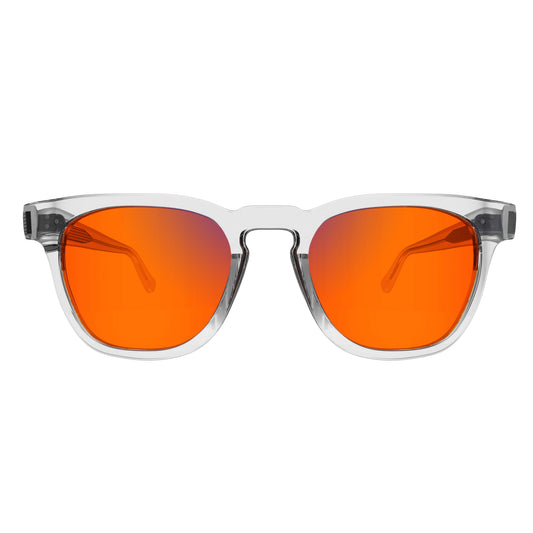
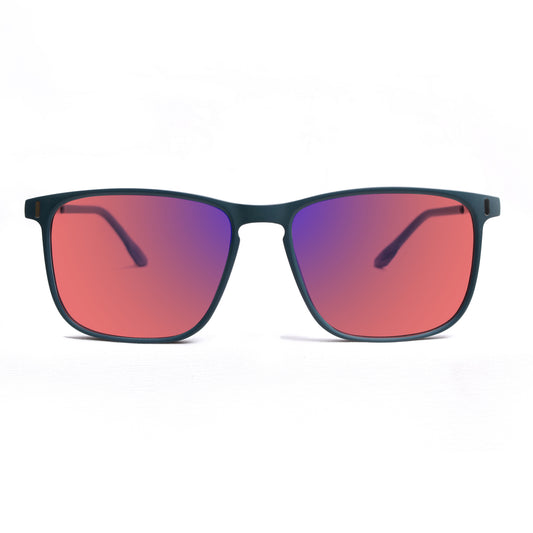
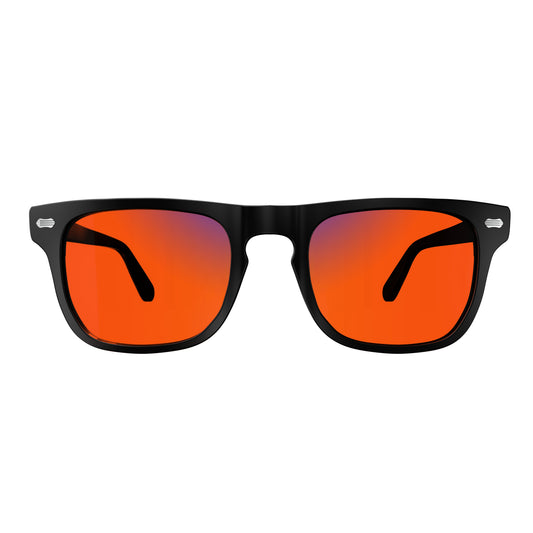
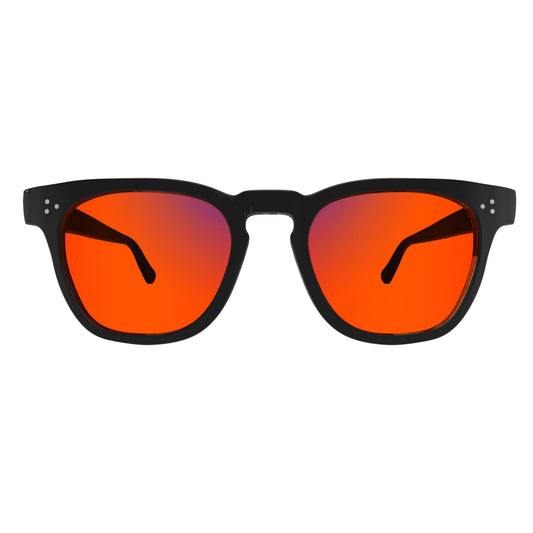
| Circadian560 | 17.2% | 3 | UV400 · 100% | Not suitable — indoor evening use |
| Red Sleep | 14.9% | 3 | UV400 · 100% | Not suitable — indoor evening use |
| Amber Evening | 50.5% | 1 | UV400 · 100% | Indoor evening; night driving not advised |
| NeuroCalm FLX+ | 21.7% | 2 | UV400 · 100% | Suitable (daytime); not for night driving |
| FL-41 Dark | 41.1% | 2 | UV400 · 100% | Indoor & screen use; night driving not advised |
| DayActive 1.0 Yellow | 76.5% | 1 | UV400 · 100% | Suitable — red / amber / green signals recognised |
| Chrome Assist Pro (in development) | 70.4% | 1 | UV400 · 100% | Suitable — red / amber / green signals recognised |
Luminous transmittance and filter category are measured instrument readings from independent test reports held on file; UV400 denotes full ultraviolet protection across 280–400nm. Where a report records REF. rather than PASS against a clause, it is because that clause describes a general-purpose sunglass and does not apply to a wavelength-selective photobiological lens; we publish the measured number either way rather than only the flattering ones. Standards testing describes optical and photobiological performance. It is not medical-device approval, and it is not a claim to diagnose, treat, cure or prevent any condition.
The research team
Suraj Dubey — Founder & Head of Research, Lead Inventor; clinical optometrist, 10+ years, 10,000+ eye examinations (ORCID 0009-0003-7510-9254)
Dr. Monica Chaudhry — Independent Clinical Advisor; 37+ years in optometry, former faculty, AIIMS New Delhi (ORCID 0000-0002-2349-8986)
Nandhini Elango — Contributing Researcher (ORCID 0009-0004-5927-5276)
Lanisha Blessy Coelho — Contributing Researcher (ORCID 0009-0005-3380-4325)
Grounded in the wider field
Our work builds on decades of peer-reviewed light science — from the foundational FL-41 photophobia research to modern circadian neuroscience on melanopsin and melatonin. We reference that science openly; we don’t claim those institutions endorse us. We claim we did our homework.
Published research and patent filings describe scientific and intellectual-property work. They do not represent medical-device approval or a claim to diagnose, treat, cure, or prevent any condition.