

The Migraine & Sleep Light Spectrum: Which Wavelengths Trigger Attacks and Ruin Sleep (2026)
Most articles about migraine and sleep glasses talk about tints — pink, amber, red. Almost none talk about the thing that actually matters: the specific wavelengths of light, measured in nanometres (nm), that trigger migraine attacks and shut down your melatonin. This guide maps them, band by band — and shows exactly which lens blocks each one.
The light spectrum, decoded
Visible light runs from about 380nm (deep violet) to 720nm (deep red). Only a few narrow bands within it drive migraine pain and disrupt sleep. Here's the map:
| Wavelength band | What it does | Migraine | Sleep |
|---|---|---|---|
| 460–490nm (blue) | Peak melanopsin / ipRGC signal | Triggers pain pathway | Strongly suppresses melatonin |
| 490–520nm (cyan) | Bright, high-flicker band | Aggravates photophobia | Suppresses melatonin |
| 520–560nm (green) | Narrow green window | May reduce pain intensity | Still suppresses melatonin at night |
| 585–600nm (amber-orange) | Cone-driven signal | Linked to pain in some people | Low sleep impact |
| 600–720nm (red) | Long wavelengths | Generally well tolerated | Melatonin-friendly |
Wavelength ranges are approximate and based on published photobiology research; individual sensitivity varies.
The blue band (460–490nm): the main villain
This is where your eye's non-visual light sensors — intrinsically photosensitive retinal ganglion cells, or ipRGCs, powered by a pigment called melanopsin — are most sensitive. That single band does two things at once: it feeds the migraine pain pathway, and it tells your brain it's daytime, crushing melatonin production. Block it well and you address migraine and sleep at the same time.
The green paradox (520–560nm)
Here's what almost no one explains. Research (Noseda et al., 2016) found that a narrow band of green light can actually reduce migraine pain intensity compared with other colours. So during a daytime migraine, you may want to preserve some green — which is exactly why a blunt lens that blocks everything can feel worse than one tuned to keep green.
But at night, that same green band still suppresses melatonin. So the ideal green strategy flips depending on time of day: preserve green for daytime migraine comfort, block it for night-time sleep.
Why ordinary FL-41 is incomplete
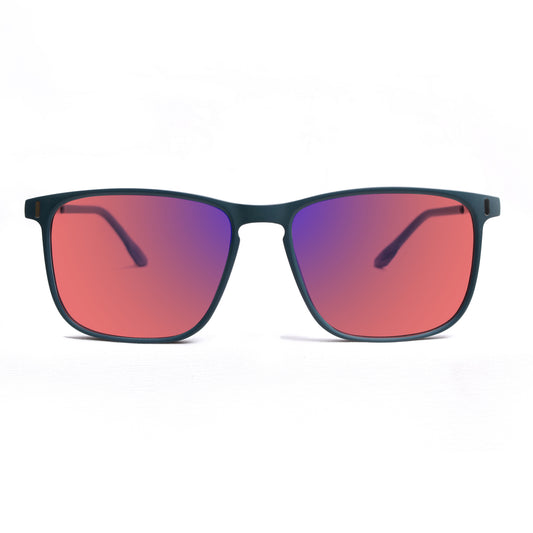
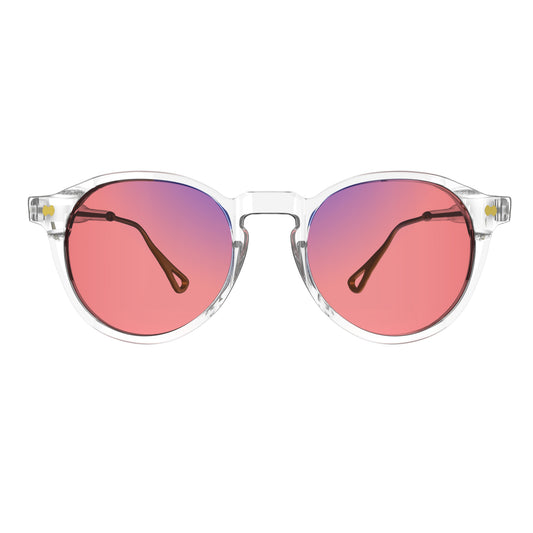
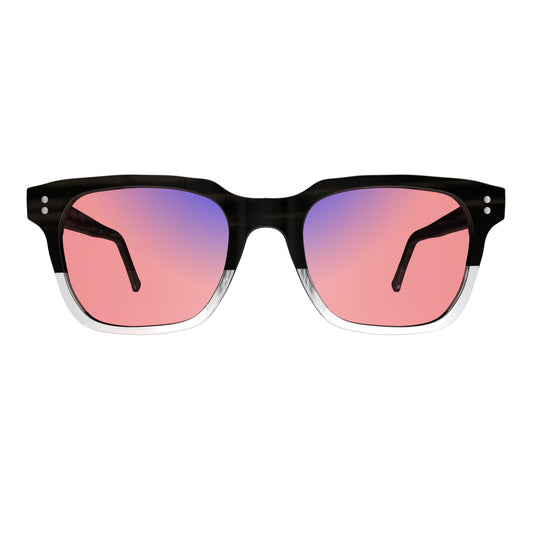
Classic FL-41 dampens one broad band (roughly 480–520nm). It helps — but it doesn't distinguish between the melanopsin band, the calming green band, and the cone band. That's why Sleepaxa engineered the patented NeuroCalm FLX+ dual-band lens: it attenuates 460–490nm and 585–600nm while deliberately preserving the 520–560nm green window. Two pain bands down, one calming band protected.
The night side: blocking to 550–560nm for sleep
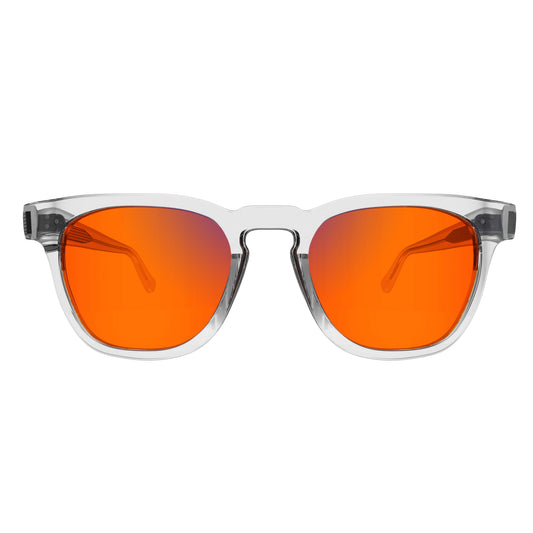
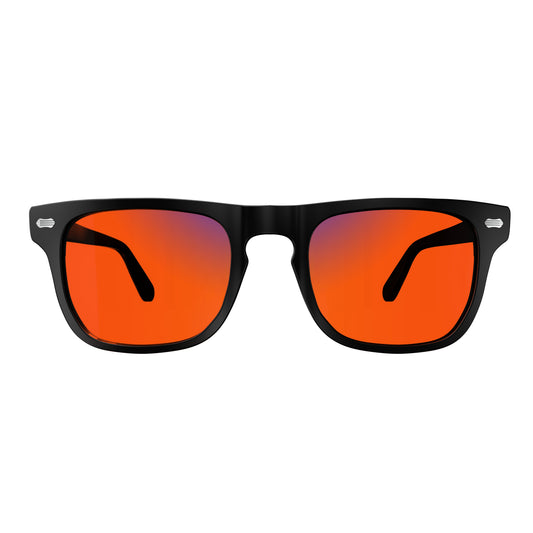
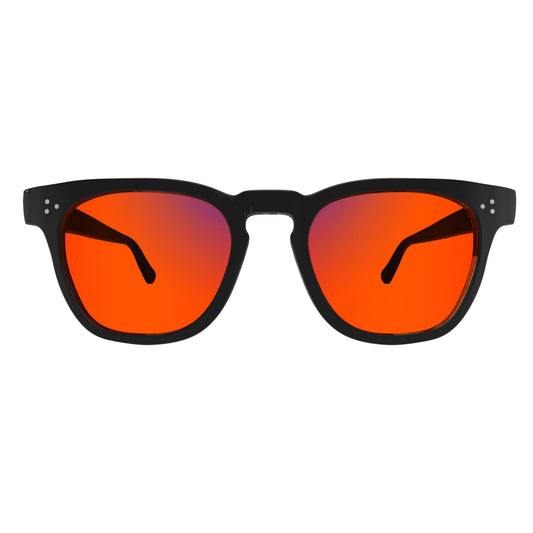
For sleep, the goal is the opposite of daytime: you want to block everything up to the edge of the melatonin-suppressing range. Sleepaxa's sleep lenses are spectrometer-verified to do exactly that — Red blocks 100% of light up to 550nm, and the flagship Circadian560 blocks 100% up to 560nm, the outer edge of the melanopsin response. That's why deep red is the most protective evening tint.
What to wear, and when
| Situation | Goal | Best lens |
|---|---|---|
| Daytime migraine / photophobia | Block pain bands, keep green | FL-41 or NeuroCalm FLX+ |
| Office / screens / bright day | Cut glare & blue | FL-41 or DayActive yellow |
| Evening wind-down | Protect melatonin | Amber or Red sleep lens |
| Maximum sleep protection | Block 100% to 560nm | Circadian560 |
Why trust these numbers?
Sleepaxa lenses are spectrometer-verified and developed at our research division, Acieon Labs, with published open-access research and granted Patent 587746. We show the numbers most brands never publish. See the research →
Frequently asked
Which wavelength triggers migraines the most?
The 460–490nm blue band, where melanopsin-driven ipRGCs are most sensitive, is most consistently linked to migraine photophobia.
Is green light good or bad for migraines?
A narrow green band (around 520–560nm) may reduce migraine pain by day, but the same band suppresses melatonin at night — so it should be preserved by day and blocked before sleep.
What blocks the most sleep-disrupting light?
A deep red lens that blocks 100% of light up to 550–560nm, the edge of the melatonin-suppressing range.
This article is for education and is based on published photobiology research. Sleepaxa lenses are engineered to help manage light sensitivity and support healthy sleep rhythms; they are not a medical device and are not intended to diagnose, treat, cure, or prevent any condition.
Tags:
Previous
Prescription & Prism Migraine Glasses: Next-Gen FL-41 in Your Exact Prescription (2026)
Next
Best Migraine Glasses 2026: An Optometrist's Honest Guide


