

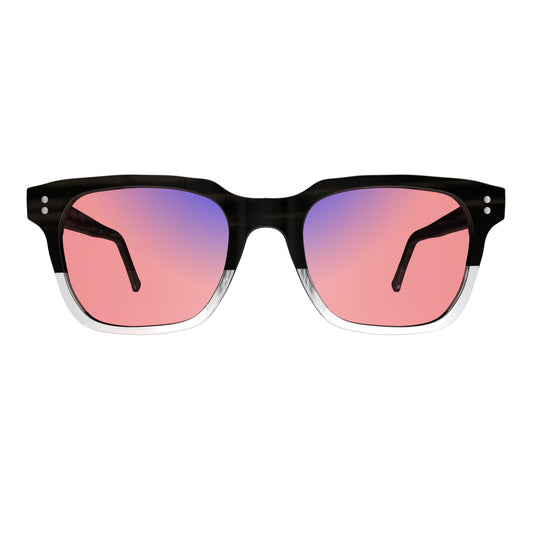
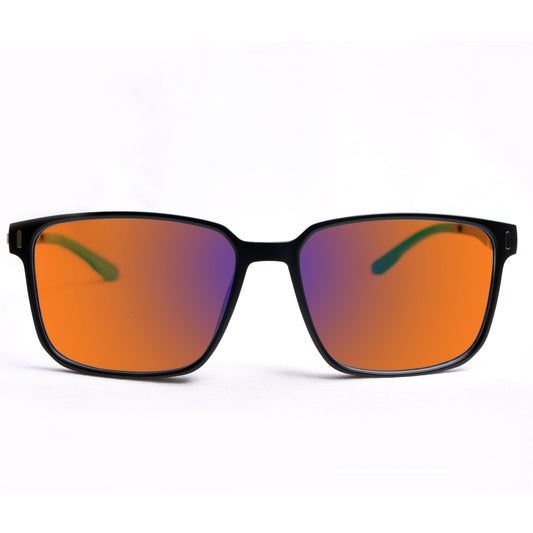

Do Blue Light Glasses Help With Migraines? What the Research Actually Says (2026)
Short answer: mostly no. Standard clear blue-light glasses filter a small slice of short-wavelength light around 400–450 nm, but the light most strongly linked to migraine photophobia sits in the blue-green band around 480–520 nm, where melanopsin cells peak. Studies that reported fewer migraine attacks used a specific rose tint called FL-41, not clear blue-light coatings. Here's the science, explained by optometrists.
Sleepaxa Optometry Team · Updated October 2026
At a glance
- Clear blue-light lenses: little evidence for migraine
- FL-41 rose tint: the most-studied lens for migraine light sensitivity
- Wavelength matters more than darkness
Why people with migraine are sensitive to light
Photophobia affects most people with migraine during attacks and many between them. The pathway is now well understood. Light reaches intrinsically photosensitive retinal ganglion cells (ipRGCs), which contain melanopsin. These cells send signals to the posterior thalamus, where they converge with pain signals from the trigeminovascular system, the network that carries migraine headache pain. That convergence is why light can make migraine pain worse.
Harvard researchers showed this pathway can operate even in people who cannot consciously see (Noseda et al., Nature Neuroscience, 2010), and later found that headache intensity worsened most with blue light and least with narrow green light (Noseda et al., Brain, 2016). We review these mechanisms in Photophobia in Migraine: Neural Mechanisms, Epidemiological Burden, and Wavelength-Selective Management (DOI 10.5281/zenodo.19644849).
The wavelength mismatch: why clear blue-light glasses fall short
| Band | Role in migraine | Clear blue-light lens | FL-41 |
|---|---|---|---|
| 400–450 nm (violet-blue) | Some contribution | Partly filtered | Strongly filtered |
| 480–520 nm (blue-green) | Melanopsin peak; key photophobia band | Mostly passes through | Strongly filtered |
| ~520–560 nm (green) | Narrow green tolerated best | Passes | Partly filtered |
| Red (620+ nm) | Comfortable for most | Passes | Preserved |
In short, a clear blue-light coating targets the wrong part of the spectrum for migraine. Our analysis of commercial products is in Limitations of Commercial Blue-Light-Filtering Spectacle Lenses (DOI 10.5281/zenodo.19762610). For eye strain too, a 2023 Cochrane review (Singh et al.) found clear blue-light lenses probably make little short-term difference.
What the research on FL-41 found
- Childhood migraine (Good et al., Headache, 1991, University of Birmingham): children wearing FL-41 tinted lenses had fewer migraine attacks than when wearing a blue tint.
- Blepharospasm (Blackburn et al., Ophthalmology, 2009, University of Utah): FL-41 improved light sensitivity and daily functioning in a condition with severe photophobia.
- Review (Katz & Digre, Survey of Ophthalmology, 2016): precision tints such as FL-41 are listed among practical non-drug options for photophobia once the cause is assessed.
The evidence base is small and older, and results vary between people. But it consistently points to selective filtering of the blue-green band, which is what FL-41 does and what clear lenses don't.
What we see in practice
As optometrists, we meet many people who bought blue-light glasses, felt nothing change, and concluded that "glasses don't work for migraine". Usually the lens was simply aimed at the wrong wavelengths. People who respond best to FL-41 typically:
- notice symptoms under fluorescent or cool-white LED lighting, or on screens
- feel the need to squint or dim screens far below other people
- get headaches that build during the working day
Not sure if that's you? Try our light sensitivity self-check.
Filter the band that matters
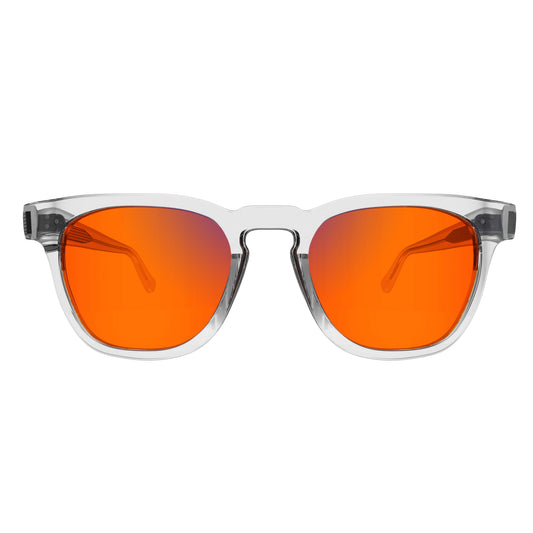
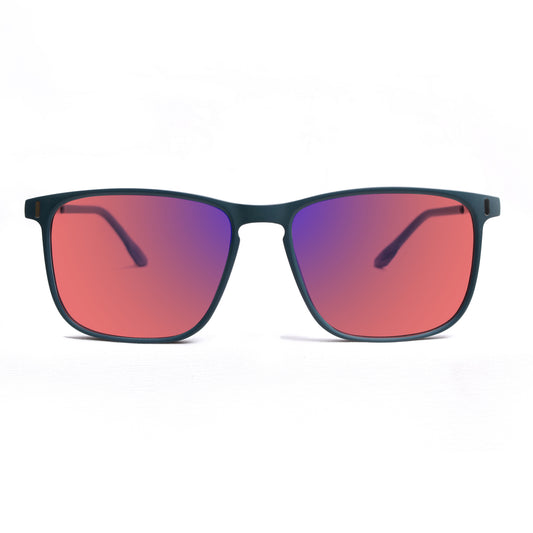
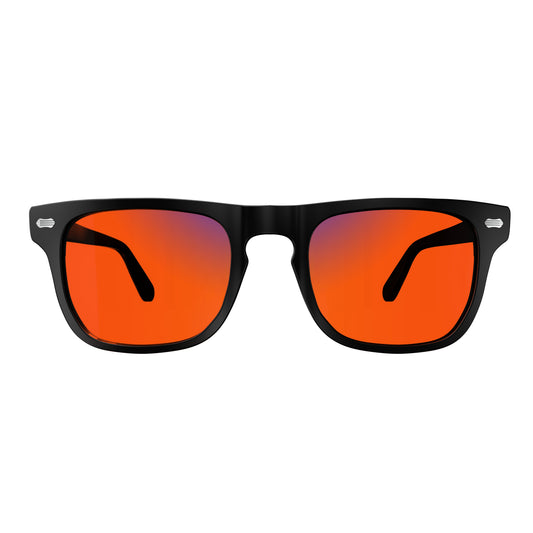
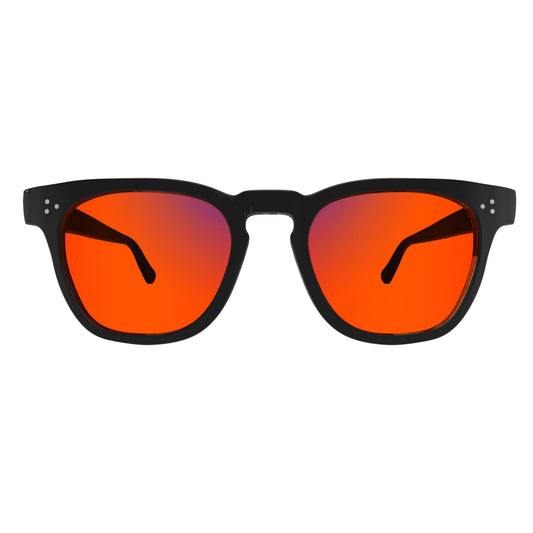
FL-41 Dark: 13.8% at 450 nm · 12.6% at 520 nm · rose band preserved · Light & Dark · zero power to prism
Shop FL-41 Glasses →How to choose a lens that actually targets migraine light
- Ask for wavelength data. "Blocks 90% of blue light" without a wavelength is meaningless.
- Check the 480–520 nm band. That's where filtering matters most for photophobia.
- Keep it wearable indoors. Very dark sunglasses indoors can increase sensitivity over time.
- Build it into your prescription if you wear glasses: prescription migraine glasses explained.
The design principle behind selective filtering is described in Wavelength-Selective Filtration in Photobiological Eyewear (DOI 10.5281/zenodo.19422123).
When to see a doctor
Get medical advice if your headaches are new, changing, or getting worse; if light sensitivity comes on suddenly with eye pain or redness; or with any "worst-ever" headache, weakness, numbness, or vision loss. Glasses help with light comfort; they don't replace diagnosis or migraine treatment.
Keep reading
- Do migraine glasses work?
- Blue-light glasses vs FL-41
- Best migraine glasses 2026
- Flickering lights and migraine
- PWM screen headaches
FAQ
Do blue light glasses help with migraines?
Clear blue-light glasses have little evidence for migraine because they filter mainly 400–450 nm, while migraine photophobia is most linked to the 480–520 nm blue-green band. FL-41 tinted lenses, which filter that band, are the most-studied option.
What color glasses are best for migraines?
A rose FL-41 tint is the most-researched. Research also suggests narrow green light is tolerated best, which is why selective filtering matters more than darkness.
Can blue light trigger a migraine?
Blue and blue-green light activate melanopsin cells that connect to migraine pain pathways, so bright blue-rich light can worsen light sensitivity and headache in susceptible people.
Are FL-41 glasses better than blue light glasses for migraine?
For light-sensitive migraine, yes: FL-41 targets the wavelengths most linked to photophobia and has published research behind it.
Should I wear sunglasses indoors for migraine?
Generally not all day; dark-adapting can increase sensitivity. A selective indoor tint like FL-41 Light is usually better.
Educational content written by optometrists, summarising published research. Individual experience varies; speak with your doctor about migraine diagnosis and treatment.
Tags:
Previous
Vestibular Migraine & Light Sensitivity: What Helps (2026)
Next
Migraine Glasses for Computer Work: Stop Screen Headaches at the Source


